

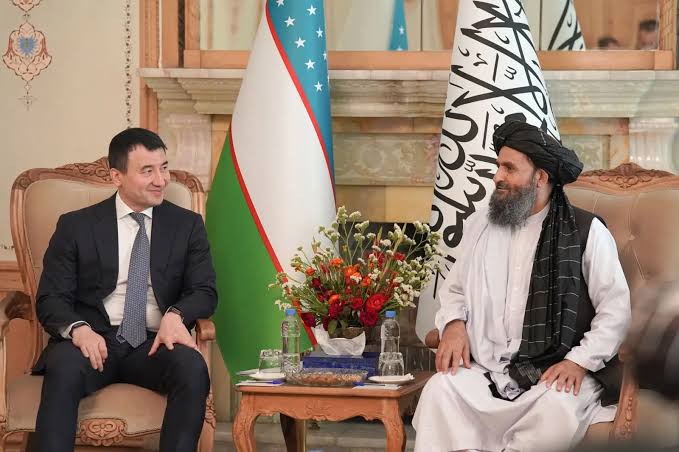
KABUL, A high-level Uzbek delegation, led by Deputy Prime Minister Jamshid Khodjaev, arrived in Kabul on Sunday to strengthen economic, political, and investment cooperation with Afghanistan, marking another step in expanding bilateral ties between the neighboring countries.
According to Afghan officials, the delegation visited Kabul on the instructions of Uzbek President Shavkat Mirziyoyev with the aim of accelerating the implementation of previously agreed trade and investment initiatives.
Afghanistan’s acting Prime Minister Mullah Mohammad Hassan Akhund received Khodjaev and his delegation at the Gulkhana Palace, according to Mullah Hamdullah Fitrat, deputy spokesman for the Islamic Emirate of Afghanistan (IEA).
The Uzbek delegation includes cabinet ministers, deputy ministers, business leaders, and investors, reflecting Tashkent’s growing interest in expanding economic engagement with Afghanistan.
During the meeting, Khodjaev said Afghanistan occupies an important place in Uzbekistan’s foreign policy and emphasized that the visit was intended to review progress on existing commitments while identifying new opportunities for cooperation.
He noted that Afghanistan exported goods worth approximately $150 million to Uzbekistan last year, while exports during the first months of the current year have already reached $111 million, with further growth expected before the end of the year.
Khodjaev also revealed that Uzbekistan has issued 5,000 visas to Afghan citizens, describing the move as evidence of expanding friendship, people-to-people exchanges, and stronger economic cooperation between the two countries.
Welcoming the delegation, Prime Minister Hassan said the visit reflected Uzbekistan’s confidence in Afghanistan’s future and represented an important milestone in strengthening bilateral relations.
He reaffirmed Afghanistan’s commitment to expanding cooperation with Uzbekistan and pledged to continue implementing agreements reached between the two governments.
The visit comes as Uzbekistan continues to promote regional connectivity, trade, and infrastructure cooperation with Afghanistan despite ongoing political and economic challenges in the country.