

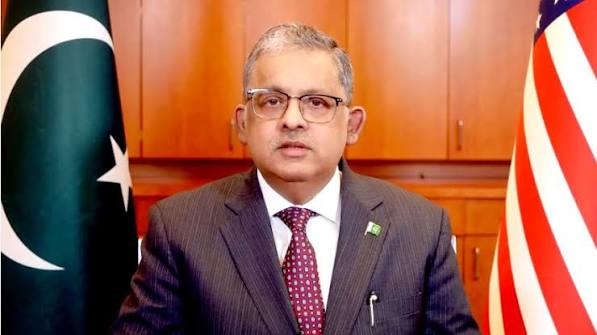
WASHINGTON: Pakistan’s Ambassador to the United States, Rizwan Saeed Sheikh, has said India’s unilateral decision in April 2025 to put the Indus Waters Treaty (IWT) “in abeyance” cannot change the treaty’s legal status or remove the rights and obligations created under it.
In an article published by Newsweek, Sheikh argued that the treaty remains legally valid and operational. He said the agreement has provided a rules-based framework for managing one of the world’s most important river systems for more than six decades.
Pakistan Rejects India’s Unilateral Position
Sheikh was responding to an article by India’s Ambassador to the United States, Vinay Kwatra.
The Pakistani envoy said India has continued to promote a narrative aimed at justifying unilateral action against the treaty. According to Sheikh, neither the IWT itself nor international law provides a legal basis for such action.
He described the Indus Waters Treaty as a binding international agreement signed on September 19, 1960, following years of negotiations facilitated by the World Bank.
More Read

Sheikh stressed that the treaty did not represent an act of Indian generosity or a concession to Pakistan. Instead, he described it as a carefully negotiated legal settlement that established specific rights and obligations for both countries.
Treaty Divides the Indus River System
Under the treaty, India received unrestricted use of the three eastern rivers: the Ravi, Beas and Sutlej.
At the same time, the agreement protects Pakistan’s rights over the three western rivers: the Indus, Jhelum and Chenab.
More Read

Sheikh said Pakistan accepted this arrangement despite its historical dependence on the eastern rivers. Pakistan subsequently undertook extensive works to reorganize its irrigation system under the treaty framework.
He argued that describing the arrangement as inherently unfair ignores the circumstances in which both sides negotiated the agreement.
According to the Pakistani ambassador, the treaty’s restrictions on India’s use of the western rivers reflect the hydrological realities of an upstream-downstream relationship. He said these safeguards remain essential for Pakistan’s water security.
Pakistan Says IWT Does Not Block Indian Hydropower
Sheikh also rejected claims that Pakistan has attempted to prevent India from developing hydropower projects.
He said the treaty allows India to build run-of-the-river hydroelectric projects on the western rivers. However, such projects must comply with the technical and operational conditions established by the agreement.
The Pakistani envoy said Pakistan’s use of the treaty’s dispute-resolution mechanism does not amount to obstruction.
More Read

Instead, he described it as an exercise of rights expressly provided under Article IX of the IWT.
Questions involving spillways, outlets, intakes, freeboard and operating criteria, he said, relate directly to safeguards that India and Pakistan negotiated as part of the treaty.
Therefore, seeking clarification, neutral determination or arbitration on such issues represents implementation of the treaty rather than its misuse.
Dispute Resolution Remains Part of the Treaty
Sheikh argued that India cannot reasonably claim the benefits of treaty provisions that permit hydropower development while rejecting the technical limitations and dispute-resolution mechanisms that form part of the same negotiated framework.
He also referred to decisions by the Court of Arbitration concerning the treaty’s continued operation and the binding nature of its provisions.
According to Sheikh, the court’s awards, including a supplemental award issued in May 2026, reinforce the principle that hydropower projects on the western rivers must comply with the limits established by the IWT.
He maintained that political or security disputes cannot erase obligations under a binding international treaty.
Pakistan Rejects Security-Based Suspension
Sheikh said allegations related to terrorism or other bilateral disputes cannot create a unilateral right to suspend, ignore or rewrite the Indus Waters Treaty.
He emphasized that the treaty contains no provision allowing either country to suspend it unilaterally or place it “in abeyance.”
He cited Article XII, which provides that the treaty will remain in force unless both governments conclude a formally ratified agreement to terminate it.
Pakistan Calls for Return to Treaty Framework
Sheikh said Pakistan remains committed to implementing the treaty according to both its letter and spirit.
He called on India to withdraw its unilateral measures, return to full compliance with its treaty obligations and use the institutional and dispute-resolution mechanisms established under the IWT.
Pakistan, he added, will continue to defend its legitimate rights under the treaty through all available means.
Water Security Is Critical for Pakistan
The Pakistani ambassador stressed that the issue goes beyond political advantage.
Pakistan’s agriculture, food security, livelihoods and broader economic well-being remain closely connected to the Indus River system.
Sheikh said the integrity of the Indus Waters Treaty therefore represents a matter of water security and the welfare of around 250 million Pakistanis.
He also emphasized the importance of international support for preserving the treaty’s integrity and stability in South Asia.