

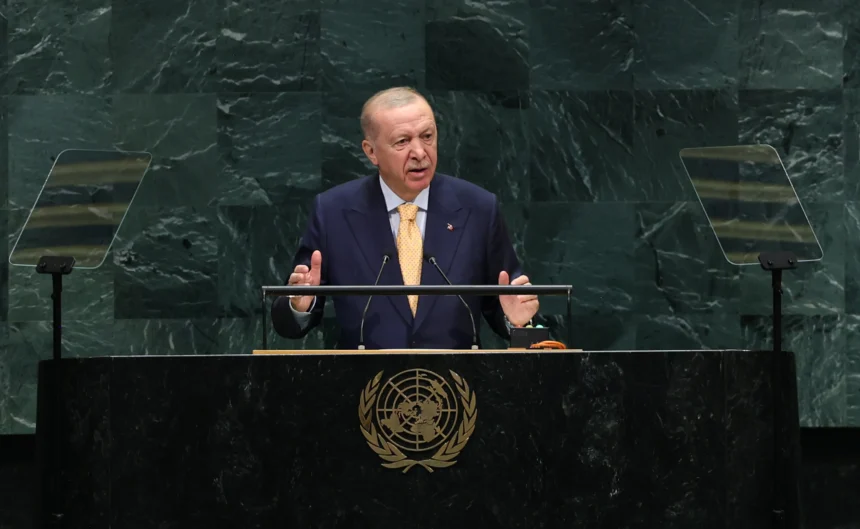
NEW YORK — Turkish President Recep Tayyip Erdogan called for urgent action on Gaza and reforms at the United Nations during his address to the 81st General Assembly.
Erdogan said the United Nations has struggled to fulfill its duty to maintain international peace. He also called for stronger regional efforts to address conflicts and security challenges.
Erdogan Highlights Gaza Crisis
The Turkish president called for Gaza’s reconstruction to begin as soon as possible. He also urged the international community to increase pressure on Israel.
Erdogan called for the establishment of an independent Palestinian state based on the 1967 borders, with East Jerusalem as its capital.
He also said efforts to block Palestinian statehood would fail. Erdogan reaffirmed his support for implementing the Gaza roadmap and a wider political process.
A joint statement by Türkiye, Pakistan, Saudi Arabia and other Arab and Islamic countries has also called for sustained US engagement to ensure implementation of the Gaza plan and to overcome obstacles to its roadmap.
Pakistan, Saudi Arabia and Türkiye
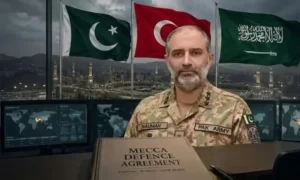
Erdogan also referred to the new defense cooperation between Türkiye, Pakistan and Saudi Arabia.
He described the arrangement as based on regional ownership. He said the three countries want to strengthen solidarity and cooperation through the framework.
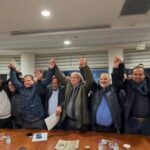
The three countries have expanded defense and security cooperation amid wider regional tensions.
Call for Freedom of Navigation
Erdogan also stressed the importance of keeping navigation through the Strait of Hormuz open.
He called for continued diplomatic efforts to promote stability in the region.
The issue has gained wider international attention because restrictions around the strategic waterway have affected energy supplies and global trade.
UN Security Council Reform
The Turkish president also criticized the current structure of the UN Security Council.
He argued that the system gives disproportionate influence to the five permanent members. Erdogan called for comprehensive reform to make the UN system more representative.
The issue has also featured prominently in wider debates over the UN’s ability to respond to major global conflicts.