

UNITED NATIONS, — The United Nations Security Council will begin the first round of informal closed-door “straw poll” voting on Thursday to gauge support for the seven candidates seeking to become the next UN Secretary-General.
The successful candidate will succeed António Guterres of Portugal, whose second five-year term ends later this year.
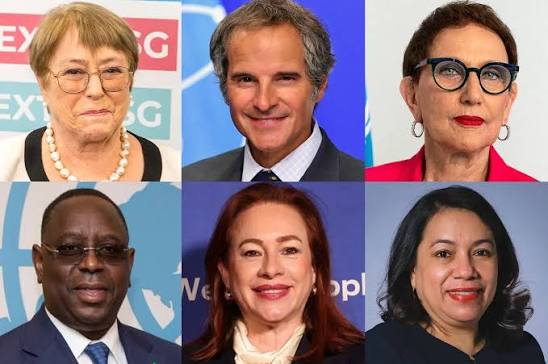
The contenders currently in the race are Rafael Grossi (Argentina), Michelle Bachelet (Chile), Rebeca Grynspan (Costa Rica), María Fernanda Espinosa (Ecuador), Carolyn Rodrigues-Birkett (Guyana), Macky Sall (Senegal), and Olara Otunnu (Uganda), who entered the contest last week. Additional candidates may still join the race.
The informal straw polls allow the Security Council’s 15 members to cast secret ballots indicating whether they “encourage,” “discourage,” or have “no opinion” about each candidate. The early rounds do not reveal whether any opposition comes from the Council’s five permanent veto-holding members—China, France, Russia, the United Kingdom, and the United States.
In later rounds, permanent members use differently colored ballots, making it clear if a candidate has received a discouraging vote from a veto power.
There is currently no clear frontrunner, and diplomats expect several rounds of voting to continue through the summer before a consensus candidate potentially emerges by late September or early October.
The next UN chief will inherit an organization facing mounting pressure to reform its bureaucracy, improve efficiency, reduce duplication across UN agencies, and restore confidence in the institution’s global leadership.
The Security Council will eventually recommend one candidate to the 193-member UN General Assembly, where formal approval is traditionally considered a final step after the Council reaches consensus.

Current Security Council President Zenon Mukongo Ngay, Permanent Representative of the Democratic Republic of the Congo, confirmed that the first straw poll will take place on Thursday morning and that Ugandan candidate Olara Otunnu will participate despite not taking part in earlier informal hearings.