

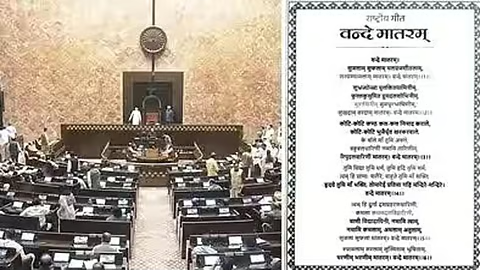
NEW DELHI, — India’s Parliament has approved a controversial bill that prescribes up to three years’ imprisonment for individuals found guilty of disrupting, obstructing, or insulting “Vande Mataram,” one of the country’s national songs.
The legislation, introduced by Minister of State for Home Affairs Nityanand Rai, will become law after receiving the assent of the President of India.
The bill faced strong opposition from several political parties, including the Indian National Congress, which argued that the legislation undermines India’s secular constitutional framework and infringes upon religious freedom.
Opposition lawmakers maintained that there was no need to mandate the complete rendition of Vande Mataram, noting that India’s Constituent Assembly had officially recognized only the first two stanzas of the song.
Critics also warned that criminalizing objections to the song could set a precedent affecting freedom of expression and constitutional rights.

Asaduddin Owaisi, President of the All India Majlis-e-Ittehadul Muslimeen (AIMIM) and Member of Parliament, described the legislation as a violation of constitutional guarantees protecting religious freedom.
Owaisi argued that Vande Mataram contains references that some religious communities consider inconsistent with their beliefs, stating that the legislation could be viewed as an attempt to impose a particular religious or cultural identity.
The All India Muslim Personal Law Board (AIMPLB) also expressed serious concern over the legislation.

In its reaction, the board said imposing a specific religious or ideological concept through legislation was inconsistent with the fundamental spirit of India’s Constitution and could undermine the country’s pluralistic character.
Defending the bill, Minister Nityanand Rai said the legislation was not directed against any individual, community, or ideology.
According to the minister, the objective of the law is to safeguard national dignity and strengthen a shared sense of national consciousness.
The legislation is expected to remain a subject of political and legal debate as opposition parties and civil society groups continue to raise concerns regarding its constitutional implications.