

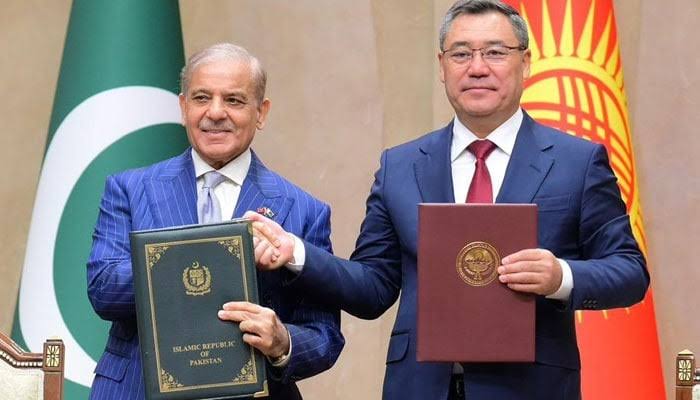
Pakistan and Kyrgyzstan have signed a series of agreements and memorandums of understanding to expand cooperation across several key sectors.
The agreements cover trade, transit, climate change, counterterrorism, information technology, education, science, health, culture and other areas.
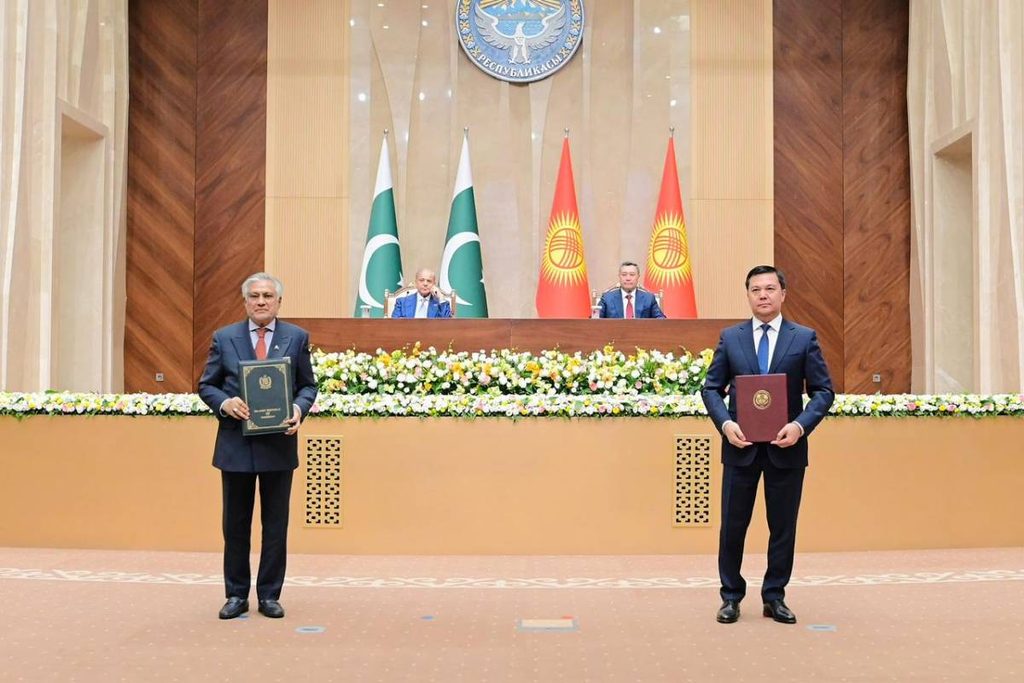
Prime Minister Shehbaz Sharif and Kyrgyz President Sadyr Zhaparov witnessed the signing ceremony in Bishkek. The two leaders later held a joint press interaction on bilateral relations and future cooperation.
Transit Trade Agreement to Improve Connectivity
Prime Minister Shehbaz Sharif welcomed the signing of the Pakistan-Kyrgyzstan Transit Trade Agreement.
He said the agreement would facilitate trade, improve logistics and create new opportunities for regional connectivity between Central and South Asia.
More Read

The two countries also agreed to simplify transport, customs and administrative procedures. They will work to remove operational obstacles affecting freight movement.
Both sides also expressed interest in using Pakistani seaports to expand Kyrgyzstan’s trade and transit opportunities.
Pakistan and Kyrgyzstan Target $200 Million Trade
The two countries have agreed to work toward increasing bilateral trade to $200 million within the next two years.
More Read
Shehbaz Sharif said the current trade volume remains far below the potential of the relationship. He called for stronger private-sector engagement and easier business procedures.
The two governments also signed an agreement specifically aimed at supporting the target. Pakistan wants greater participation from businesses and increased commercial opportunities between the two countries.
Cooperation on Security and Counterterrorism
Security and defence cooperation also featured prominently in the discussions.
Shehbaz Sharif said Pakistan and Kyrgyzstan would work together against terrorism, extremism and other emerging security threats.
The two sides also signed agreements covering extradition, mutual legal assistance in criminal matters and cooperation against the illicit trafficking of narcotics and related substances.
Lahore and Osh Become Sister Cities
Pakistan and Kyrgyzstan also agreed to establish a sister-city relationship between Lahore and Osh.
Shehbaz Sharif said the arrangement would strengthen cultural and people-to-people ties between the two countries.
The two sides also agreed to expand cooperation in education, science and technology, healthcare, culture and tourism.
Climate Change and Environmental Cooperation
Climate change and environmental protection also formed part of the new cooperation framework.
The two countries signed an MoU to strengthen collaboration on environmental protection and climate-related challenges.
They also agreed to expand cooperation in science, technology and other areas that can support sustainable development.
CASA-1000 and Energy Cooperation
Energy remains another important area of the Pakistan-Kyrgyzstan partnership.
Shehbaz Sharif welcomed the establishment of a joint working group on energy. The group will focus on electricity, hydropower, renewable energy, infrastructure and modern technologies.
The two sides also reaffirmed their commitment to the timely implementation of the CASA-1000 project, which aims to strengthen electricity connectivity between Central and South Asia.
Broader Economic and Digital Cooperation
The new agreements also seek to strengthen private-sector and digital cooperation.
Pakistan Post and Kyrgyz Post agreed to cooperate in postal services and e-commerce. Meanwhile, the two countries signed an MoU on cooperation in virtual assets.
The agreements also cover business-to-business links, investment, technology and infrastructure.
A New Phase in Pakistan-Kyrgyzstan Relations
Prime Minister Shehbaz Sharif said Pakistan wants to further strengthen its fraternal relationship with Kyrgyzstan.
The latest agreements provide a broader framework for economic, security, energy and people-to-people cooperation.
With the new transit trade agreement and the $200 million trade target, both countries are seeking to turn their close political ties into stronger economic and regional connectivity.