

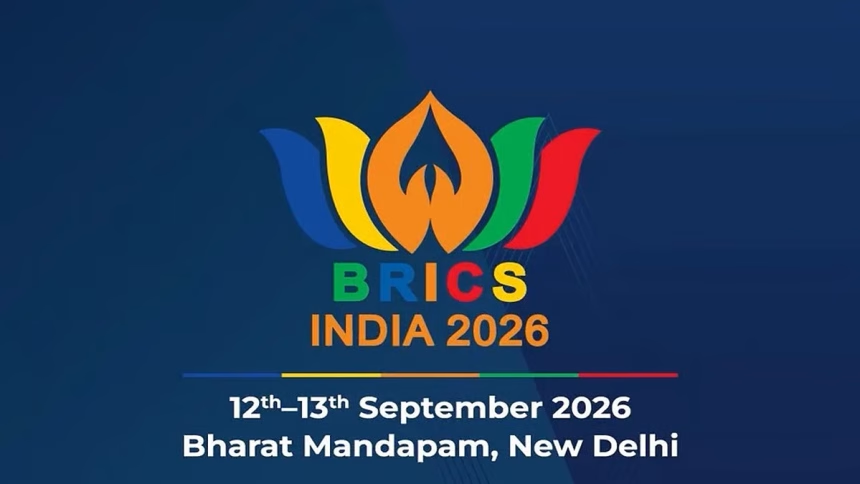
NEW DELHI, — BRICS members have agreed on a joint declaration ahead of their leaders’ summit in New Delhi, according to four sources cited by Reuters.
The agreement marks an effort to show unity despite deep divisions over the Gulf conflict. Iran and the United Arab Emirates hold opposing positions in the conflict.
The declaration is not expected to name any country. However, it will condemn unilateral war by any country, the sources said. BRICS leaders were expected to approve the document later on Saturday.
BRICS Seeks Unity on Middle East Conflict
The agreement follows difficult negotiations among BRICS members.
Diplomats faced a key challenge over the wording on the Middle East conflict. They needed language that both Tehran and Abu Dhabi could accept.
BRICS foreign ministers failed to issue a joint statement after their meeting in New Delhi in May. Differences between Iran and the UAE blocked an agreement at that time.
The latest deal could therefore help the bloc present a more united position at the leaders’ summit.
India Balances Regional Ties
India is hosting the summit while maintaining close ties with several sides of the conflict.

New Delhi has strong relations with the United States, Russia, Iran, Israel and the Gulf Arab states. Prime Minister Narendra Modi has also pushed BRICS members to expand trade and reduce barriers.
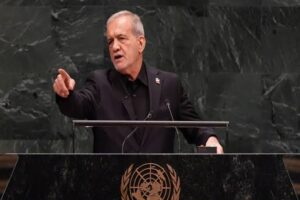
Modi met Iranian President Masoud Pezeshkian in New Delhi before the summit. He stressed the need to protect freedom of navigation, maritime trade and the safety of seafarers.
India has also called for disputes to be resolved through dialogue and diplomacy.
BRICS Wants Greater Global Influence
BRICS is seeking a larger role in global economic and political affairs.
The group has called for reforms at institutions such as the International Monetary Fund, World Bank and World Trade Organization. Members argue that emerging economies need a stronger voice in global decision-making.
BRICS finance ministers and central bank governors also recently called for more representative international financial institutions. They backed stronger cooperation on cross-border payment systems.

The bloc also wants to improve trade among its members. India is promoting lower trade barriers and closer economic cooperation.
BRICS Membership Expands
BRICS was formed in 2009 by Brazil, Russia, India and China. South Africa joined in 2011.
Egypt, Ethiopia, Iran and the UAE joined in 2024. Indonesia became a member in 2025.
The group now represents more than 40% of the world’s population and nearly a quarter of the global economy.
Leaders attending the New Delhi summit include Russian President Vladimir Putin, Chinese President Xi Jinping, Iranian President Masoud Pezeshkian and South African President Cyril Ramaphosa.
UAE President Sheikh Mohamed bin Zayed Al Nahyan’s brother, Crown Prince Sheikh Khaled bin Mohamed bin Zayed Al Nahyan, is also attending.
China’s Xi arrived in New Delhi on Saturday for the summit. His visit is his first to India in seven years. He is also scheduled to hold talks with Modi.
A Test for the Expanded Bloc
The joint declaration gives BRICS an opportunity to demonstrate that its expanded membership can still produce consensus.
However, major differences remain among members.
The agreement also comes as the Middle East conflict continues to disrupt energy markets, shipping and global trade. For BRICS, the ability to maintain a common position could shape its wider ambitions for a greater role in international affairs.