

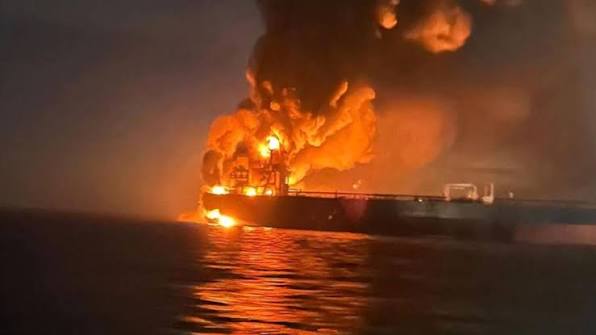
CAIRO/DUBAI, A drone strike targeting vessels at Egypt’s Damietta Port, near the Suez Canal, has heightened concerns that the ongoing conflict between the United States and Iran could spread further, threatening one of the world’s most critical maritime trade routes.
According to Egyptian authorities, an unidentified drone struck two vessels at Damietta Port on Wednesday, igniting a fire that was later brought under control. An initial investigation confirmed that the incident was caused by a drone, although no group has claimed responsibility.
Trading sources told Reuters that the attack hit the U.S.-owned gas storage tanker Energos Winter, with the resulting fire spreading to another nearby vessel.
The Egyptian government said security agencies were taking all necessary measures to safeguard national security and ensure the continued safety of maritime operations near the Suez Canal.
The incident came hours after the U.S. military announced fresh strikes on command centers and drone facilities belonging to Iran’s Islamic Revolutionary Guard Corps (IRGC). Washington said the attacks were carried out in retaliation for recent Iranian strikes targeting U.S. military forces across the Middle East.

Iranian state media reported that U.S. airstrikes killed three civilians and wounded two children on Qeshm Island, while three IRGC personnel were also reported killed in Zanjan Province. Authorities also said residential buildings, including student dormitories in Ahvaz, sustained damage during the attacks.
In response, the IRGC claimed responsibility for striking the U.S.-operated Azraq Air Base in Jordan, describing the attack as retaliation for American military action. Jordan’s armed forces later announced that they had intercepted five Iranian missiles heading toward its territory.
Meanwhile, Kuwaiti authorities reported that an Iranian strike hit a building owned by a Chinese company in northern Kuwait, killing one worker and causing significant structural damage.

The conflict has also drawn Saudi Arabia more directly into military operations. For the first time since the war began, Saudi forces publicly joined U.S. strikes against Iran-aligned armed groups in eastern Iraq after drone attacks targeted Saudi oil infrastructure.
Despite participating in the joint operation, Saudi officials have reportedly urged Washington to avoid further escalation. According to Reuters, Saudi Defence Minister Prince Khalid bin Salman met U.S. Vice President JD Vance in Washington to emphasize the importance of preventing the conflict from widening.
The current conflict began in February following U.S. and Israeli military operations against Iran. A temporary ceasefire reached in June later collapsed amid renewed fighting centered on the Strait of Hormuz, prompting growing concerns over regional shipping security.
With attacks now reported in Iraq, Jordan, Kuwait, Iran, and Egypt, analysts warn that the conflict could increasingly threaten major international energy and trade routes, including both the Strait of Hormuz and the Suez Canal.
Global energy markets reacted sharply to the latest developments. Brent crude oil prices surged by more than eight percent on Wednesday before easing slightly on Thursday, remaining close to $90 per barrel amid continuing geopolitical uncertainty.