

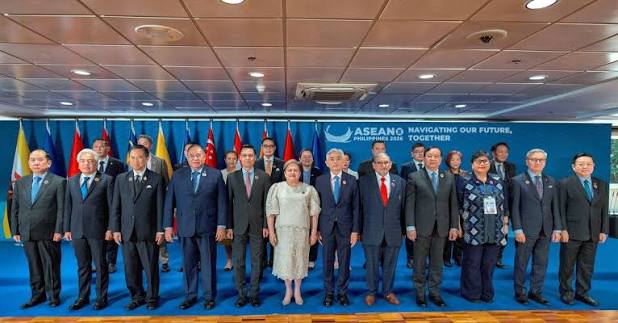
MANILA: Foreign ministers from the Association of Southeast Asian Nations (ASEAN) have expressed “serious concern” over the escalating conflict in the Middle East, warning that the renewed hostilities threaten regional stability, global energy security, and ongoing diplomatic efforts to restore peace.
Meeting in Manila alongside representatives from major global powers, the ministers issued a joint statement urging all parties to exercise restraint and prioritize dialogue over military confrontation.
The statement noted that the worsening situation in the Middle East has undermined mediation efforts and reduced prospects for a peaceful resolution through diplomacy. The conflict has also heightened concerns over global oil supplies, particularly through the Strait of Hormuz, a vital shipping route for international energy markets.
Southeast Asian nations, many of which rely heavily on imported energy, fear that prolonged instability could fuel inflation, disrupt supply chains, and slow economic growth across the region. ASEAN is therefore accelerating discussions on a regional oil-sharing mechanism to improve energy security during potential supply disruptions.
Myanmar and South China Sea Also High on Agenda
Beyond the Middle East, ASEAN foreign ministers are also focusing on the ongoing civil conflict in Myanmar, where the bloc’s peace initiative has struggled to make progress five years after the military takeover that plunged the country into prolonged violence.
More Read

The ministers are also expected to discuss negotiations on a long-awaited Code of Conduct for the South China Sea, aimed at reducing tensions and preventing maritime disputes from escalating between ASEAN member states and China.
Philippines-China Maritime Tensions
The diplomatic meetings come amid fresh tensions in the South China Sea, after the Philippines accused members of the Chinese Coast Guard of assaulting a Philippine naval serviceman near the disputed Second Thomas Shoal. China rejected the allegation and announced that it had summoned the Philippine ambassador over the incident.
The United States condemned what it described as China’s “dangerous and aggressive” actions, accusing Beijing of continuing a pattern of provocative behavior against Philippine maritime operations.
More Read

Rubio and Wang Yi Expected to Hold Talks
The ASEAN meetings will also be attended by senior officials from the United States, China, Japan, India, Australia, South Korea, Russia, the United Kingdom, and the European Union.
U.S. Secretary of State Marco Rubio and Chinese Foreign Minister Wang Yi are expected to hold bilateral discussions on the sidelines of the summit.
Ahead of the meetings, Rubio reaffirmed Washington’s commitment to freedom of navigation in the Indo-Pacific, warning that unrestricted access to international waterways remains essential for regional security and economic stability. He also reiterated U.S. support for the 2016 international arbitration ruling that rejected China’s expansive claims in the South China Sea, a ruling Beijing continues to reject.
The Manila meetings are expected to address a broad range of regional and international security challenges as ASEAN seeks to strengthen cooperation amid rising geopolitical tensions.