

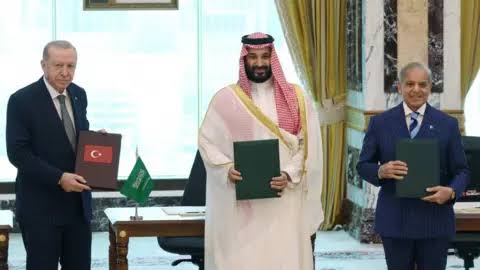
Pakistan will lead the secretariat of the joint defence agreement signed by Turkiye, Pakistan and Saudi Arabia in Makkah on August 7, 2026, according to Turkish and international media reports.
Pakistan will hold the secretariat’s leadership for the first three years. After that, the responsibility will pass to Saudi Arabia and then Turkiye.
The secretariat will oversee the implementation of decisions taken by the three countries. It will also serve as a coordination center for joint defence cooperation.
Pact Based on Collective Security
The agreement is based on the principle of collective security.
Under the pact, an armed attack against one member will be treated as an attack against all three countries. However, the response will not be automatic.
More Read
Instead, the three countries will decide their response based on the nature of each incident and the request of the country affected.
This approach gives the members flexibility when responding to external threats.
High-Level Council to Guide Cooperation
The agreement provides for a high-level council involving foreign ministers, defence ministers and military chiefs.
More Read
The council is expected to meet twice a year. It will help guide joint decisions and strengthen coordination among the three countries.
The structure has some similarities with NATO’s collective defence model. However, the agreement does not require an automatic military response.
Instead, possible measures could range from intelligence sharing and logistical support to direct military assistance.
Defence Technology Cooperation
The cooperation will also cover the defence industry.
Unmanned systems, electronic warfare and artificial intelligence have been identified as priority areas.
The three countries also plan to conduct joint military exercises. These exercises will help improve coordination between their armed forces and command structures.
Pakistan’s Role in Regional Defence Cooperation
Pakistan’s initial leadership of the secretariat carries significance beyond an administrative role.
The arrangement reflects Pakistan’s growing role in regional defence diplomacy. It also builds on the country’s existing defence ties with Saudi Arabia.
The three countries are seeking closer coordination as security challenges continue to affect the Middle East and wider region.
Pact Not Directed Against Any Country
Turkiye has made clear that the agreement is not directed against any specific country.
The pact instead focuses on collective security and closer defence cooperation among its members.
The flexible response mechanism also allows the three countries to assess each security situation separately before deciding on further action.