

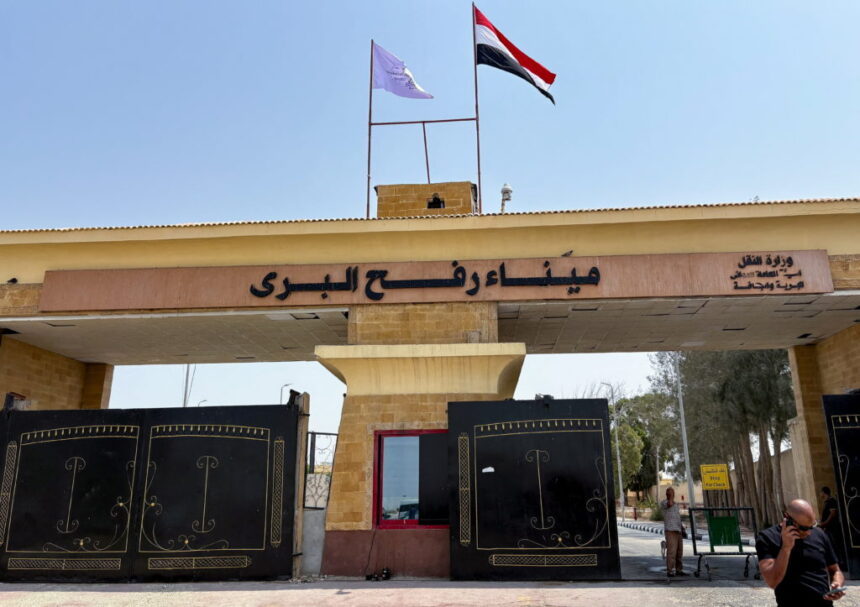
Residents of Gaza are awaiting the arrival of a newly formed technocratic body tasked with administering the territory, following Israel’s announcement of a partial reopening of the Rafah border crossing with Egypt.
The move allows limited daily travel into and out of Gaza and is seen as a key step linked to the US-backed ceasefire agreement that took effect on October 10. The agreement includes the establishment of the National Committee for the Administration of Gaza (NCAG), a 15-member panel composed of Palestinian technocrats.
Ali Shaath, head of the committee, said in a post on social media platform X that the official reopening of the Rafah crossing would be announced once final logistical arrangements among all parties are completed. He explained that Sunday would serve as a trial day to test operational procedures, with full implementation expected to begin Monday.
According to sources cited by regional media, members of the committee are expected to enter Gaza on Sunday or Monday, pending Israeli approval. However, the sources said delays persist due to what they described as continued Israeli hesitation.
Israel’s military coordination body, COGAT, confirmed on Friday that Rafah would reopen under strict conditions, emphasizing significant limits on passenger movement. The crossing will operate in both directions, but only a restricted number of travelers will be allowed to pass each day.
More Read

Travel through Rafah will be coordinated with Egyptian authorities and will require prior Israeli security clearance. The process will be overseen by a European Union monitoring mission, using the same operational framework that was in place earlier in January 2025.
Under the new rules, only Gaza residents who left the territory during the war will be permitted to return, and only after passing security screening. Travelers will undergo an initial inspection by EU monitors at Rafah, followed by a secondary identity check at an Israeli military checkpoint.
Israeli media reports indicate that no more than 150 individuals per day will be allowed to enter Gaza from Egypt. Attempts by Israel to establish a direct military presence at the crossing were reportedly unsuccessful. Instead, Israeli security services will monitor the crossing remotely using advanced surveillance systems, including cameras, sensors, metal detectors, and facial recognition technology.

Israeli Prime Minister Benjamin Netanyahu has stated that Israel will retain security control over the Rafah crossing. Israeli outlets have also reported that wounded Palestinian fighters of lower rank may be allowed to leave Gaza for treatment, while senior figures would remain restricted. Those permitted to exit would, in principle, be allowed to return.
On the Palestinian side, preparations have reportedly begun to compile lists of patients approved for travel through Rafah. If the technocratic committee is allowed to enter Gaza, it is expected to hold meetings with existing Hamas-run administrative bodies to coordinate a gradual transfer of authority.
Further discussions are also planned with Palestinian factions, civil society representatives, and community leaders to address Gaza’s humanitarian needs and future governance structure.