

US President Donald Trump arrived in China on Wednesday for a major official visit that is expected to shape the future of relations between the world’s two largest economies. Trump is scheduled to hold a two-day summit with Chinese President Xi Jinping amid growing tensions over trade, artificial intelligence, and instability in the Middle East.
The visit comes at a sensitive moment for global diplomacy as Washington and Beijing attempt to stabilize their fragile relationship while facing mounting economic and geopolitical challenges.
According to reports, President Trump was accompanied by a high-level American delegation that included Elon Musk, Jensen Huang, US Secretary of State Marco Rubio, and senior trade and technology officials.
Grand Welcome in Beijing
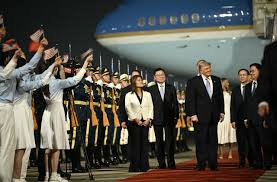
President Trump received a formal state welcome upon his arrival in Beijing, where Chinese officials, military honor guards, and hundreds of students gathered at the airport to greet the American delegation.
Students waved American and Chinese flags while chanting welcome slogans in Mandarin. Trump briefly waved to the crowd after stepping off Air Force One before proceeding to official meetings with Chinese leadership.
More Read

The carefully choreographed reception signaled Beijing’s intention to project stability and diplomatic engagement despite continuing disagreements with Washington on several strategic issues.
Trade War and Economic Disputes at Center of Talks
One of the main objectives of Trump’s visit is expected to be easing tensions in the ongoing US-China trade dispute, which has disrupted global markets and affected supply chains across multiple industries.
Before departing for China, Trump wrote on social media that he intended to urge President Xi to “open up” the Chinese economy further to American businesses and investors. The US president emphasized the importance of providing American companies with greater access to Chinese markets, particularly in the technology and artificial intelligence sectors.

A major focus of the discussions is expected to involve NVIDIA, which is seeking regulatory approval to expand sales of advanced AI semiconductor chips in China. US technology firms have faced increasing restrictions and regulatory uncertainty amid the intensifying competition between Washington and Beijing over artificial intelligence dominance.
Analysts believe the outcome of these discussions could influence the future direction of global technology markets and AI development.
Iran Conflict and Strait of Hormuz Crisis Add Urgency
In addition to trade and technology, both leaders are expected to discuss the escalating conflict involving Iran and growing security concerns surrounding the Strait of Hormuz, one of the world’s most critical energy shipping routes.
The Strait of Hormuz remains vital for global oil transportation, and any prolonged instability in the region could trigger major disruptions in energy markets and international trade.
Experts say the worsening Middle East situation has increased pressure on both Washington and Beijing to coordinate efforts aimed at maintaining global economic stability. China remains heavily dependent on Middle Eastern energy imports, while the United States is closely monitoring the security implications of the conflict.
Political analysts believe discussions between Trump and Xi may include strategies to prevent wider regional escalation and reduce risks to global oil supplies.

China Signals Willingness for Cooperation
Chinese Foreign Ministry spokesman Guo Jiakun welcomed Trump’s visit and emphasized Beijing’s desire to strengthen ties with the United States based on “equality, mutual respect and shared interests.”
According to Chinese officials, both countries are prepared to expand dialogue and cooperation in areas including economic development, regional security, and global stability.
The comments reflect Beijing’s effort to maintain diplomatic engagement despite ongoing disagreements over tariffs, technology restrictions, Taiwan, and military influence in the Indo-Pacific region.
Preliminary Talks Held Ahead of Summit
Prior to Trump’s arrival, US trade negotiator Scott Bessent held preliminary discussions with Chinese representatives in South Korea.
Chinese state media described the talks as “constructive and in-depth,” although no significant agreements or breakthroughs were publicly announced.
Diplomatic observers say the preliminary negotiations were intended to lay the groundwork for the Trump-Xi summit and identify areas where both sides could potentially reduce tensions.
Global Implications of Trump-Xi Meetings
The meetings between Trump and Xi Jinping are being closely monitored by governments, investors, and multinational corporations around the world.
Analysts warn that deteriorating relations between the United States and China could further weaken global economic growth, intensify technology rivalries, and complicate efforts to manage ongoing international crises.
At the same time, any signs of improved cooperation between the two powers could help calm financial markets and reduce uncertainty surrounding global trade and energy supplies.
The summit is also expected to influence future discussions on artificial intelligence regulations, semiconductor exports, strategic competition, and international security coordination.
With conflicts in the Middle East continuing to threaten energy markets and global inflation concerns remaining high, the outcome of the Beijing meetings could carry major consequences far beyond Washington and Beijing.