

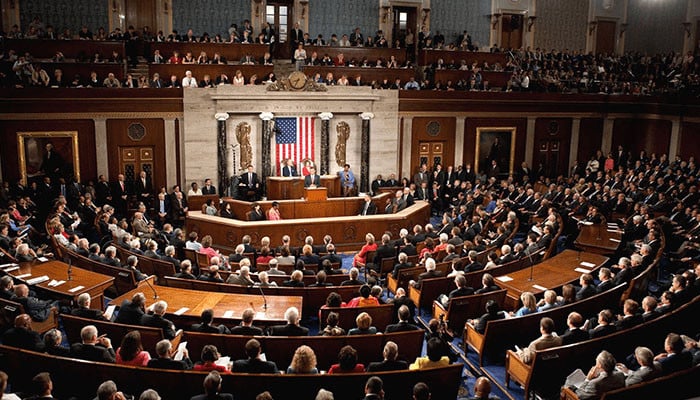
The United States Senate on Wednesday blocked another Democratic-led attempt to restrict President Donald Trump from continuing military involvement in the conflict with Iran without formal authorization from Congress.
Despite the measure’s failure, support for limiting presidential war powers showed signs of gradual bipartisan growth as three Republican senators joined most Democrats in backing the proposal.
The Senate voted 50-49 against advancing the resolution introduced by Senator Jeff Merkley, marking the seventh time this year Republicans have blocked similar legislation aimed at reining in Trump’s authority over the Iran conflict.
Three Republicans Break Ranks
Republican Senators Rand Paul, Susan Collins, and Lisa Murkowski voted alongside Democrats in favor of advancing the resolution.
However, Democratic Senator John Fetterman sided with Republicans to block the measure.
More Read

The narrow margin highlighted growing concerns within Congress over the constitutional limits of presidential military authority, particularly as the conflict with Iran continues despite White House claims that hostilities have eased.
Debate Over the 60-Day War Powers Deadline
The Senate vote carried additional significance because it was the first major congressional action since the conflict surpassed the 60-day limit established under the War Powers Resolution of 1973.
The law, passed after the Vietnam War, restricts a US president from engaging in prolonged military action without congressional approval. Under the statute, presidents may conduct military operations for only 60 days before seeking authorization from Congress or requesting a temporary extension due to military necessity.

On May 1, President Trump declared that a ceasefire had effectively “terminated” the conflict with Iran, arguing that the legal deadline no longer applied.
Democrats strongly disputed that interpretation, insisting military operations and hostilities remain active in the region.
Democrats Say Conflict Is Still Ongoing
Speaking before the vote, Senator Merkley argued that the ongoing naval confrontations between US and Iranian forces demonstrate that the conflict is far from over.
According to Merkley, the United States continues to enforce blockades on Iranian ports and conduct military operations targeting Iranian vessels, while Iran maintains pressure in the Strait of Hormuz through attacks on shipping routes and American-linked tankers.
“There’s not a cessation of war hostilities,” Merkley told reporters, emphasizing that both nations remain actively engaged in military confrontation.
Democratic lawmakers say Trump’s administration cannot legally bypass Congress while continuing military operations in the Middle East.

Democrats Promise Weekly War Powers Challenges
Following the failed vote, Merkley and other Democratic senators pledged to continue introducing war powers resolutions every week until either the conflict ends or Trump formally seeks congressional authorization for military action.
Democrats in the United States House of Representatives have also introduced similar measures, though Republican lawmakers have repeatedly prevented those efforts from advancing.
The repeated legislative battles underscore growing political divisions in Washington over the scope of executive military authority during international crises.
Constitutional Concerns Intensify
Democratic lawmakers argue that the United States Constitution clearly grants Congress — not the president — the authority to declare war.
Critics of the administration warn that the United States risks becoming trapped in a prolonged regional conflict without a clearly defined strategy or congressional oversight.
Supporters of the resolutions say requiring authorization from Congress would provide greater transparency, accountability, and public debate regarding America’s military objectives in the Middle East.
Republicans aligned with Trump, however, have largely defended the president’s authority to respond rapidly to security threats involving Iran and regional shipping lanes.
Middle East Conflict Continues to Shape US Politics
The ongoing confrontation with Iran has become one of the most contentious foreign policy issues facing the Trump administration in 2026.
Tensions surrounding attacks on shipping routes, instability in the Strait of Hormuz, and broader concerns over energy markets have intensified international pressure on Washington and Tehran.
The debate in Congress reflects wider concerns that the conflict could evolve into a larger and longer regional war with major economic and geopolitical consequences.
Political analysts say future Senate votes may become increasingly competitive if military operations continue and public pressure for congressional oversight grows.