

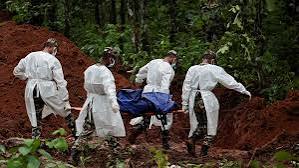
Nepal has begun the mass burial of hundreds of unidentified people who died after devastating floods swept through parts of the country.
The burials are taking place in Chitwan, a district known for its forests and rivers. Authorities have turned part of the Devghat forest area into a temporary burial site for victims whose bodies can no longer be identified.
According to Reuters, officials have dug hundreds of graves around 200 kilometres from the flood-hit valleys.
Authorities face public health concerns
Chitwan District Officer Ganesh Aryal said authorities had little choice but to begin the burials.
The bodies were decomposing rapidly, creating serious public health concerns. As a result, officials decided to bury unidentified victims while continuing efforts to establish their identities.
More Read

Authorities buried 96 unidentified bodies in the forest on Saturday. They planned to bury more than 100 additional bodies on Sunday.
Meanwhile, rescue teams continued searching rivers and piles of debris for more victims.
Hundreds remain missing
According to the report, sudden floods triggered by glacier-related events in valleys near Nepal’s border with China have killed around 750 people.
More Read

More than 3,000 people remain missing, according to the figures cited in the report.
About 100 rescue workers, police officers and government officials are working to document the recovered bodies. They are also taking photographs and helping families identify their missing relatives.
Authorities are keeping detailed records of every burial site. They have also placed identification markers both above and below the ground.
In addition, officials have collected DNA samples from the bodies. This will allow authorities to exhume and return remains to families if they establish an identity later.
India and China assist identification efforts
India has sent a forensic team to help Nepal analyse DNA samples.
Nepal is also cooperating with a Chinese team as authorities try to identify the victims.
The international assistance could help families establish the identities of relatives who remain missing after the disaster.
Temporary morgues struggle to handle bodies
The situation has also overwhelmed temporary morgue facilities.
At Bharatpur Hospital, the strong smell of decomposing bodies could reportedly be detected nearly 200 metres from the temporary morgue.
Around 50 police officers and hospital employees are working to handle the bodies.
Reuters was allowed to look inside the entrance of the temporary morgue, where around 125 bodies were lying on the floor. The number was more than twice the facility’s intended capacity of 50 bodies.
Inspector Anil Thapa, who oversees a disaster response centre, said the bodies were decomposing quickly.
He said more than half of the bodies recovered so far had become difficult to identify. In several cases, the faces were no longer recognisable.
Families wait for news of missing relatives
More than 200 people have gathered outside the Chitwan Expo Centre in the hope of finding missing family members.
Authorities have arranged for relatives to view photographs of recovered bodies. Families can use the images to make a preliminary visual identification.
Many families have travelled from remote areas to reach the centre. Some said they had arrived a day earlier but were still waiting to enter the hall.
Nearby, officials have converted an old single-storey building into another temporary storage facility for bodies.
Workers have placed the bodies in body bags and kept them on beds. They are using dry ice, air conditioners and industrial cooling units to slow decomposition.
Rescue teams continue recovering bodies
The scale of the operation remains immense.
According to Reuters, a vehicle carrying 13 bodies arrived at the temporary centre during the rescue operation.
By 10 a.m., six ambulances stood outside the facility. Another vehicle carrying recovered bodies was also waiting for space.
Meanwhile, grieving relatives continued to wait outside. Many still hoped that officials might recover and identify their loved ones.
Rescue workers face emotional strain
The disaster has also taken a heavy emotional toll on the people handling the bodies.
Inspector Anil Thapa described the conditions as extremely difficult. He said the smell and scale of the tragedy had affected his ability to eat and even drink water while working at the centre.
The authorities now face two urgent tasks: identifying as many victims as possible and ensuring that the mass burial process preserves enough information for future identification.