

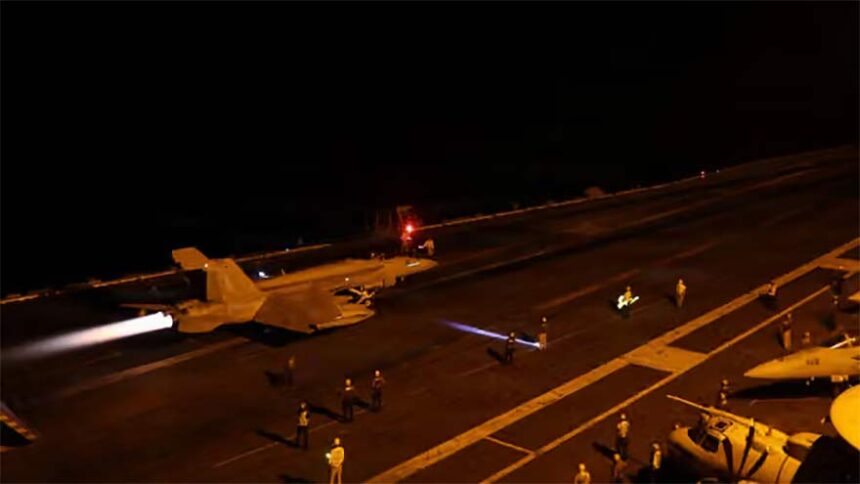
WASHINGTON/DUBAI: The United States launched new air strikes on Iranian targets on Tuesday. The move has raised fears of a wider escalation around the Strait of Hormuz.
US Central Command said American forces targeted Islamic Revolutionary Guard Corps (IRGC) positions in Iran. CENTCOM said the strikes followed recent attempted Iranian attacks on commercial shipping and US personnel in the region.
The latest attacks came after a new exchange of fire between the United States and Iran. As a result, hopes for a pause in hostilities have weakened.
US Targets IRGC Positions
CENTCOM said the strikes began at noon Eastern Time, or 1600 GMT.
The US command said Iran had recently attempted attacks against commercial vessels in the Strait of Hormuz. It also cited attacks against American service members in the region.
More Read

The latest US action adds to a series of strikes against Iranian military targets since the conflict began.
Earlier, CENTCOM said its forces had targeted Iranian military sites, coastal defenses and maritime capabilities. The US has said these operations aim to protect commercial shipping in the strategic waterway.
Explosions Reported Across Southern Iran
Iranian state media reported explosions at several locations.

Reports mentioned explosions on Qeshm Island, which lies near the northern side of the Strait of Hormuz.
Iranian media also reported explosions in Bandar Abbas and Chabahar. Further reports mentioned blasts or explosion sounds in Jask and Sirik.
Independent verification of the full extent of the damage was not immediately available.
Trump Warns of Stronger Response
US President Donald Trump warned Iran against retaliating for the latest strikes.
Trump said Iran would face a much stronger response if it attacked the United States again.
Meanwhile, Iranian officials maintained a defiant position. The Fars news agency quoted an IRGC spokesperson as saying that the United States would regret the new attacks.

The latest exchange has increased concern that the conflict could spread further across the region.
Strait of Hormuz Under Pressure
The renewed fighting has also increased pressure on the Strait of Hormuz.
The waterway is one of the world’s most important routes for oil and gas shipments. However, shipping activity has fallen sharply during the current crisis.
Preliminary data showed only five commercial vessels passed through the strait on Monday. No liquid tankers were recorded among those vessels.
Iran has also warned that it could prevent oil exports from the Gulf if its own exports remain blocked.
That threat has raised fresh concerns about global energy supplies.
Oil Prices Rise
Oil prices climbed sharply after the latest US strikes.
Brent crude rose to around $93.93 a barrel, while US West Texas Intermediate crude reached about $89.48. Both benchmarks gained roughly 4% on Tuesday.
The increase reflects growing fears that prolonged fighting could disrupt energy supplies from the Middle East.
The Strait of Hormuz carries a major share of global oil trade. Therefore, any prolonged disruption could affect fuel prices and global markets.
Washington Plans More Sanctions
The military strikes also came alongside new economic pressure on Tehran.
US Treasury Secretary Scott Bessent said Washington is likely to announce sanctions against an Iranian bank this week. He also indicated that further sanctions could follow.
The measures are part of a wider US effort to pressure Iran financially.
At the same time, Iran’s leadership has continued to signal that it is prepared to resist US pressure.
The latest strikes now leave the region facing renewed uncertainty over whether the conflict will expand further.