

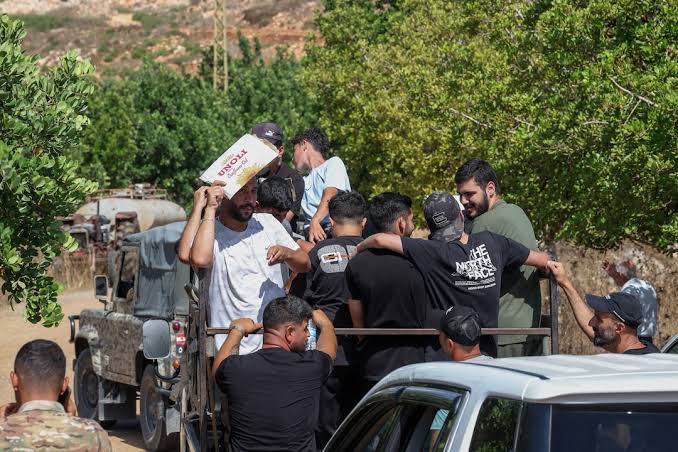
BEIRUT, Lebanon: Residents of the southern Lebanese town of Zawtar al-Gharbiyeh began returning to their homes on Friday after Israeli forces withdrew from the area and the Lebanese Army deployed under a U.S.-brokered security arrangement aimed at reducing tensions along the border.
The return was marked by scenes of devastation, with residents walking through streets filled with rubble to inspect homes that had been heavily damaged or completely destroyed during months of fighting.
Mayor Abed Ezzeddin said more than half of the town had been destroyed, while many of the remaining buildings suffered severe structural damage.
“We’ve been waiting for this moment for almost five months,” resident Mohammed Darwish said as he entered the town. He added that families were eager to inspect their properties but had not yet been informed whether they would be permitted to remain overnight.
Another resident, Abu Ali Ezzeddin, said the destruction would not force him to abandon his hometown.
More Read

“My house is destroyed, and my children’s house is destroyed. Everything is destroyed,” he said. “I plan to stay because my livelihood is here.”
The Lebanese Army began deploying in Zawtar al-Gharbiyeh earlier this week after Israeli forces withdrew from the area, marking the first implementation phase of a U.S.-mediated agreement reached between Lebanon and Israel through indirect negotiations.
Under the arrangement, the Lebanese Army is expected to deploy in designated areas and confiscate weapons from the Iran-backed Hezbollah movement, while Israeli troops withdraw in stages. The Israeli military has identified Zawtar al-Gharbiyeh as one of three locations included in the pilot phase of the plan.
More Read

Despite the withdrawal, Israeli forces continue to control a stretch of territory extending roughly 10 kilometers (6 miles) inside southern Lebanon, where several villages have reportedly been extensively damaged or demolished.
As a result, tens of thousands of displaced Lebanese residents remain unable to return to their hometowns following the conflict that erupted between Israel and Hezbollah on March 2.
Israeli forces also continued conducting controlled demolitions in nearby areas still under their control during the week.
Meanwhile, Lebanese Army engineering units have been clearing mines and unexploded ordnance from Zawtar al-Gharbiyeh. Ambulances entered the town on Thursday to recover the bodies of Hezbollah fighters killed during clashes.
A senior Lebanese military official said significant clearance operations must still be completed before the town can be declared safe for permanent civilian return.
Separately, Hezbollah’s parliamentary bloc criticized the Lebanese Army’s deployment, describing it as largely symbolic rather than a substantive security measure.