

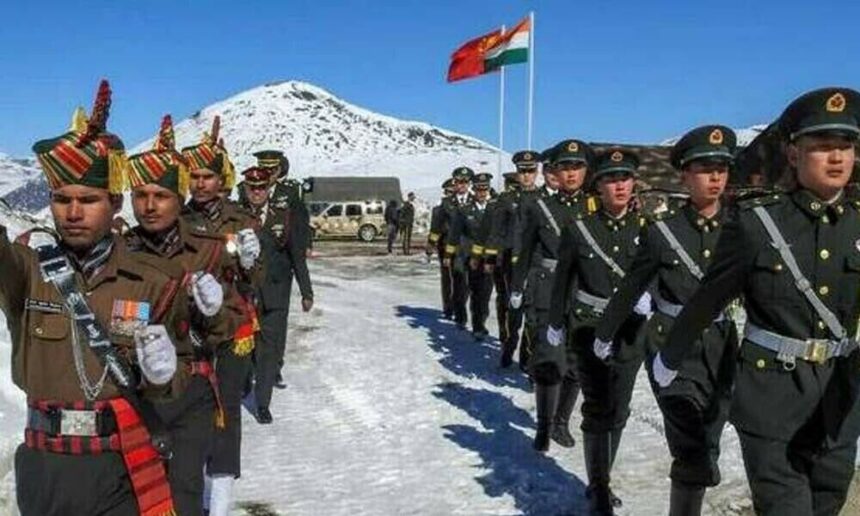
NEW DELHI: Tensions have resurfaced along the disputed Himalayan border between India and China following reports of a confrontation between their border forces.
Indian officials have said that New Delhi is closely monitoring developments along the border.
India Calls for Peace Along Border
Indian Foreign Ministry spokesperson Randhir Jaiswal said during a media briefing that India takes border issues with China very seriously.
He also called for peace along the disputed border.
Jaiswal said peace and stability in the border areas remain important indicators of the direction of India-China relations.
More Read

Meanwhile, reports from Indian media have raised fresh concerns about activity near the disputed frontier.
Reports of Chinese Patrol in Arunachal Pradesh
According to ThePrint, Indian and Chinese patrol teams reportedly came face to face in the Taksing area of Upper Subansiri district in Arunachal Pradesh in late July.
The report claimed that Chinese personnel entered about 2.5 kilometers into an area under Indian control.
More Read

The Chinese personnel later withdrew from the area, according to the report.
However, the report said Chinese personnel returned to the area in early August.
They allegedly set up two tents there.
Indian Officials Reject Unverified Reports
Indian defense officials have rejected the reports.
They described the claims as unverified and said they could not confirm them independently.
An Indian defense spokesperson in Arunachal Pradesh said there was no reliable confirmation of the reported developments.
However, a fact-finding committee linked to a local political group in Arunachal Pradesh has raised concerns.
The committee described the reports of an alleged Chinese incursion near Taksing as a serious matter.
China Describes Situation as Stable
China has also commented on the situation along the border.
Chinese authorities have described the overall situation as stable.
The Chinese Foreign Ministry said both countries remain in contact through diplomatic and military channels.
Beijing also said the two sides have agreed to maintain peace and stability in the border areas.
2020 Clash Still Affects India-China Relations
The latest reports come against the backdrop of the long-running India-China border dispute.
Relations suffered a major setback after deadly clashes in eastern Ladakh in 2020.
The June 2020 Galwan Valley clash killed 20 Indian soldiers and four Chinese soldiers, according to the two governments.
After the clash, both countries deployed tens of thousands of troops along the Line of Actual Control (LAC).
The military standoff continued for several years.
India and China Made Progress in 2024
India and China made progress toward reducing border tensions in 2024.
Indian Prime Minister Narendra Modi and Chinese President Xi Jinping held talks that year.
The two sides later agreed on patrol arrangements in some disputed areas.
This agreement helped complete troop disengagement from certain locations.
Both governments have since taken steps to gradually improve bilateral relations.
Border Talks Continue
India and China have continued discussions on border management and related issues.
In May 2026, officials held talks on border management, demarcation and communication mechanisms.
The two countries have also worked to restore trade, diplomatic contacts and people-to-people links.
However, the border dispute remains one of the biggest challenges in their relationship.
Peace Remains Key to Better Relations
Indian Foreign Minister S. Jaishankar also stressed the importance of peace along the border.
During a meeting with Chinese Foreign Minister Wang Yi in July, Jaishankar said peace and stability in border areas remain essential for normal bilateral relations.
Former Indian Army chief General Upendra Dwivedi also said in June that the situation along the LAC was stable.
However, he warned that the area remained sensitive.
Military deployments from both sides continue in the region.
For now, both India and China appear focused on maintaining communication and preventing another major escalation along the disputed Himalayan frontier.