

ISLAMABAD: Pakistan has strongly rejected the allegations contained in Amnesty International’s recent report regarding the country’s military operations along the Afghan border, describing the claims as unsubstantiated and lacking credible evidence.
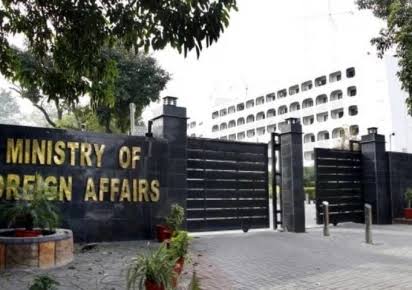
Addressing the Ministry of Foreign Affairs’ weekly press briefing on Thursday, Foreign Office Spokesperson Tahir Hussain Andrabi said Pakistan categorically rejects the report, arguing that it overlooks the root cause of terrorism originating from Afghan territory.
He stated that all military operations conducted by Pakistan were carried out in accordance with international law and under the country’s legitimate right to self-defense.
Concerns Over Cross-Border Terrorism
The spokesperson said that terrorist organizations, including the Tehreek-e-Taliban Pakistan (TTP), the Balochistan Liberation Army (BLA), and affiliated militant groups, continue to operate from safe havens inside Afghanistan under the Taliban administration.
According to Andrabi, these groups have planned and launched cross-border terrorist attacks against Pakistan, resulting in the deaths of thousands of Pakistani citizens.
More Read
He emphasized that Pakistan’s military operations have been limited to terrorist hideouts and logistical facilities, while observing the principles of proportionality and precaution to minimize civilian harm.
Pakistan also urged the international community to recognize the primary source of regional instability and called on Amnesty International to examine the continued presence and support of terrorist organizations in Afghanistan, as well as the Taliban administration’s obligations under UN Security Council resolutions and the Doha Agreement.
Condemnation of Houthi Threats
The Foreign Office also strongly condemned recent threats by Yemen’s Houthi militia against Saudi Arabia and commercial shipping in the Red Sea.
More Read
The spokesperson warned that any hostile action against Pakistani-flagged vessels or Pakistan’s maritime interests would be regarded as a serious threat to national security.
He stressed that Pakistan reserves the right to take all necessary measures under international law to protect its maritime interests and national security.
Reaffirming Pakistan’s unwavering support for the sovereignty, security, and territorial integrity of Saudi Arabia, Andrabi expressed concern over efforts to further escalate tensions in the Middle East and reiterated Pakistan’s support for diplomacy and dialogue as the only path to lasting peace.
Active Diplomatic Engagement
Highlighting Pakistan’s diplomatic efforts, Andrabi referred to the recent visit of Iranian Interior Minister Eskandar Momeni, who met Prime Minister Shehbaz Sharif, Pakistan’s Interior Minister, and senior military leadership.
He added that Deputy Prime Minister and Foreign Minister Ishaq Dar recently held meetings with the foreign ministers of Kuwait, Egypt, Oman, and Russia on the sidelines of regional meetings in Manila, discussing regional stability, maritime security, de-escalation, and bilateral cooperation.
The spokesperson also confirmed that Ishaq Dar will lead Pakistan’s delegation to the upcoming Shanghai Cooperation Organization (SCO) Council of Foreign Ministers meeting, where he is expected to hold several bilateral engagements.
More Read
He noted that Pakistan also reaffirmed its commitment to regional peace, dialogue, and cooperation during the 31st ASEAN Regional Forum Ministerial Meeting in Manila.
Pakistan-Canada Relations
Commenting on bilateral relations with Canada, Andrabi described the recent visit of Canadian Foreign Minister Anita Anand as the first visit of its kind in nearly two decades.
He said both countries discussed expanding cooperation in trade, investment, climate change, regional affairs, and people-to-people exchanges.
GSP+ and European Union
Responding to questions regarding the European Commission’s latest GSP+ monitoring report, the spokesperson welcomed the report’s acknowledgment of Pakistan’s legislative progress and continued implementation of the 27 international conventions under the GSP+ framework.
However, he expressed disappointment that the report did not present a balanced assessment of Pakistan’s achievements since joining the GSP+ scheme in 2014.
He noted that the GSP+ arrangement remains a cornerstone of Pakistan-EU economic relations, supporting exports, employment, women’s economic participation, and poverty reduction.
Afghanistan and Palestinian Issue
The spokesperson reiterated Pakistan’s commitment to facilitating Afghan nationals through legal channels, stating that more than 90,000 Afghan citizens have so far been assisted in relocating to third countries.
He emphasized that Afghan nationals residing in Pakistan must possess valid legal documentation, while those staying illegally would be subject to deportation under Pakistani law.
At the same time, he rejected any attempt to promote hatred or negative stereotyping against ordinary Afghan citizens.
Reaffirming Pakistan’s longstanding support for the Palestinian cause, Andrabi said Islamabad remains in close contact with Islamic countries and continues to advocate for the establishment of an independent Palestinian state in accordance with international law.
Pakistan’s Position on Kashmir
Responding to another question, the spokesperson said Pakistan will continue to raise its voice against alleged human rights violations in Indian Illegally Occupied Jammu and Kashmir (IIOJK).
He also referred to convicted Indian spy Kulbhushan Jadhav, describing the case as clear evidence of India’s attempts to destabilize Pakistan.