

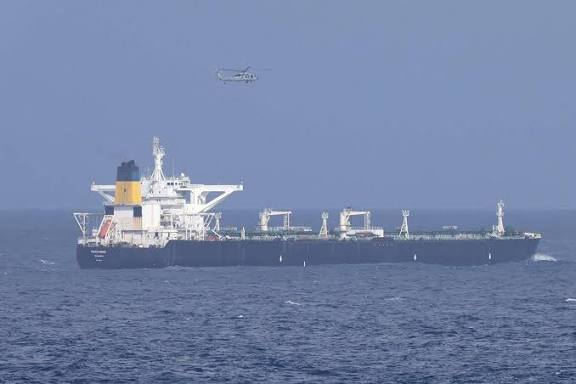
RED SEA: Two Chinese supertankers carrying a combined 4 million barrels of Saudi Arabian crude oil have successfully exited the Red Sea through the Bab al-Mandab Strait, according to shipping data, despite an ongoing maritime blockade imposed by Yemen’s Houthi movement.
While some reports circulating online claimed the vessels departed with “special permission” from the Houthis, no official confirmation or independent evidence has verified that claim.
According to LSEG shipping data, the Singapore-flagged VLCC Xin Long Yang, which had paused and made a U-turn in the central Red Sea on Tuesday, resumed its southbound voyage late Wednesday before exiting the waterway on Thursday.
The Chinese-flagged VLCC Cosnew Lake followed a similar route, with both tankers successfully clearing the Red Sea.
Shipping records show that Xin Long Yang is heading to Qinzhou Port in China’s Guangxi Province, while Cosnew Lake is expected to discharge its cargo at Huizhou Port in Guangdong Province.
More Read

Automatic Identification System (AIS) data indicated that both vessels had Chinese crews on board. The tankers were chartered by Unipec, the trading arm of China’s largest refiner Sinopec, after loading Saudi crude oil at the Yanbu export terminal earlier this week.
Meanwhile, at least two additional Very Large Crude Carriers (VLCCs) also chartered by Unipec have slowed their approach toward the Bab al-Mandab Strait. According to LSEG tracking data, the vessels are currently circling in the Gulf of Aden instead of proceeding directly to Yanbu to load additional Saudi crude later this month.
The Houthi blockade has added further pressure to global energy markets, coming at a time when renewed tensions between the United States and Iran have also disrupted shipping through the strategically important Strait of Hormuz.
More Read

Energy analysts warn that continued instability in both maritime chokepoints could further affect global oil supplies, shipping routes, and international energy prices.